Introduction
Every function in a living cell is ultimately carried out by proteins. The central dogma of molecular biology — proposed by Crick in 1970 — describes how genetic information flows from DNA to RNA to protein.1 Proteins rarely act in isolation; the full repertoire of protein–protein interactions (PPIs) within a cell or tissue constitutes its interactome. Mapping the interactome is therefore fundamental to understanding cellular function and disease mechanisms. For example, disruption of specific PPIs has been implicated in the pathogenesis of the autoimmune disease multiple sclerosis,2 where hub proteins such as TNF, IL-6, IFNG, and STAT3 coordinate complex interaction networks (Figure 1).
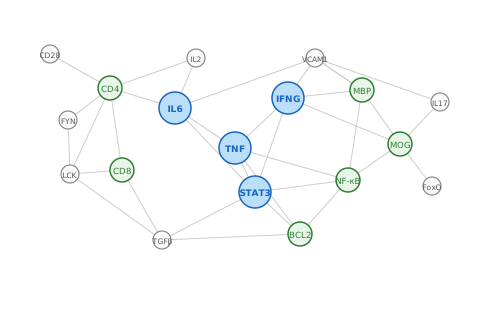
Identifying all PPIs within a pathway — the interactome mapping problem — is technically challenging. High-throughput approaches such as yeast two-hybrid screens and co-immunoprecipitation mass spectrometry are valuable but can be laborious, prone to false positives, or unable to provide kinetic information. There is a need for intermediate-throughput, label-free methods that can confirm candidate interactions with high confidence and provide quantitative binding data.
This application note demonstrates the use of the P4SPR to screen protein–protein interactions in the enterobactin biosynthetic pathway of Escherichia coli. Enterobactin is a siderophore assembled by the EntA–F family of enzymes. Among these, EntB and EntE are known interacting partners.3 Here, EntF was immobilized on the sensor surface and EntA–D were injected in parallel, enabling concurrent screening of four analytes against the same receptor in a single experiment.
Experimental Procedures
1Surface Preparation
(EDC/NHS)
- AffiCoat gold sensor treated with EDC/NHS
- Wash with sodium acetate
(20 min)
- EntF (10 µg/mL) immobilized on sensor surface
(10 min)
- 1 M ethanolamine pH 8.5 to block active sites
- Equilibrate channels
- EntA–D injected in parallel channels A–D concurrently
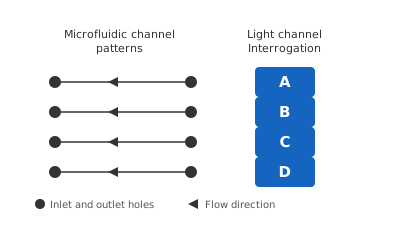
The P4SPR quad-inlet microfluidic design (Figure 2) enables four independent channels to be operated simultaneously. Each channel receives a separate analyte injection while sharing the same immobilized receptor surface, making it ideal for side-by-side comparison of binding partners.
2Troubleshooting: Glycerol Artifact
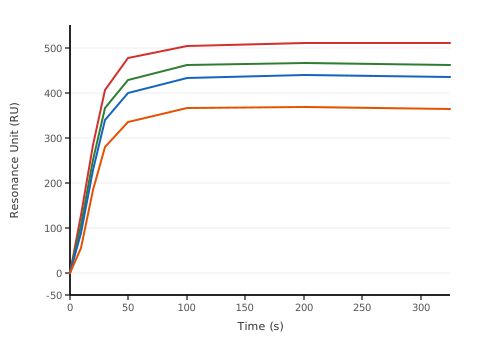
Initially, protein injections showed sharp simultaneous increases in signal across all four channels (Figure 3). This artifact was caused by excess glycerol in the ligand storage buffer, which has a higher refractive index than the standard running buffer. Because SPR is sensitive to bulk refractive index changes, the glycerol produced a large non-specific signal indistinguishable from binding. A buffer exchange using a filter column (molecular weight cut-off appropriate to the protein) removed excess glycerol prior to subsequent experiments, eliminating this artifact.
Results and Discussion
After buffer exchange, EntF was successfully immobilized on the AffiCoat gold sensor surface and the baseline was stable across all four channels. Analytes EntA, EntB, EntC, and EntD were each injected into one channel and the binding response was monitored in real time over 1300 seconds. The red and grey traces (Figure 4) show clear association phases — a characteristic rise in resonance units — indicating protein–protein interaction between EntF and the injected analytes (EntB and EntE, respectively, the known interacting partners).3 In contrast, the green and blue traces remain flat at baseline, confirming that EntA and EntC do not interact with EntF under these conditions.
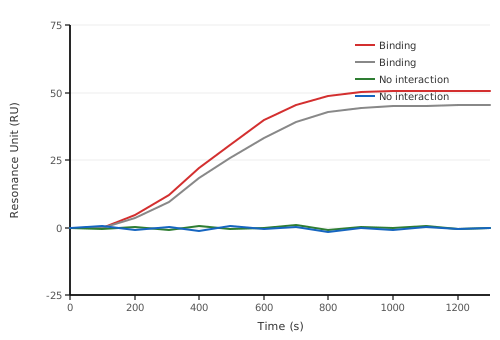
The P4SPR successfully identified binding partners of EntF within the enterobactin biosynthetic pathway, confirming the known EntB–EntE interaction and screening additional pathway members simultaneously across four channels.
The P4SPR Advantage
Multi-target Screening
Four independent channels allow simultaneous testing of EntA, B, C, D against the same immobilized receptor in one run.
Rapid Troubleshooting
Manual injection and real-time signal monitoring allow assay issues (like glycerol artifacts) to be identified and corrected immediately.
Label-free Detection
No modification of the analyte proteins required; native binding is observed in real time without fluorescent or radioactive labels.
Interactome Mapping
Ideal for pathway-focused PPI studies where an intermediate-throughput, accurate method is needed to confirm and rank candidate interactions.
Conclusion
This study demonstrates the feasibility of using the P4SPR™ to conduct interactome studies by mapping PPIs in the enterobactin biosynthetic pathway of E. coli. The four-channel design enabled concurrent screening of multiple pathway proteins (EntA–D) against the immobilized EntF receptor. Combined with the ease of manual injection and real-time signal monitoring, the P4SPR is well-suited for rapid, accurate mapping of protein–protein interactions in biological pathways and drug discovery workflows.
Acknowledgements
We thank Cory Campbell from Dr. Peter Pawelek's research group at Concordia University for his insight and the collection of these data. Author: Dr. April Wong.
1 Crick, F. Central dogma of molecular biology. Nature 1970, 227, 561–563.
2 Ragnedda, G. et al. Protein–protein interaction analysis highlights additional loci of interest for multiple sclerosis. PLoS One 2012, 7, 1–7.
3 Khalil, S.; Pawelek, P. D. Ligand-induced conformational rearrangements promote interaction between the Escherichia coli enterobactin biosynthetic proteins EntE and EntB. J. Mol. Biol. 2009, 393, 658–671.